


Blog
Grade 1 to Grade 4 Piles: How Ayurvedic Treatment Changes by Severity

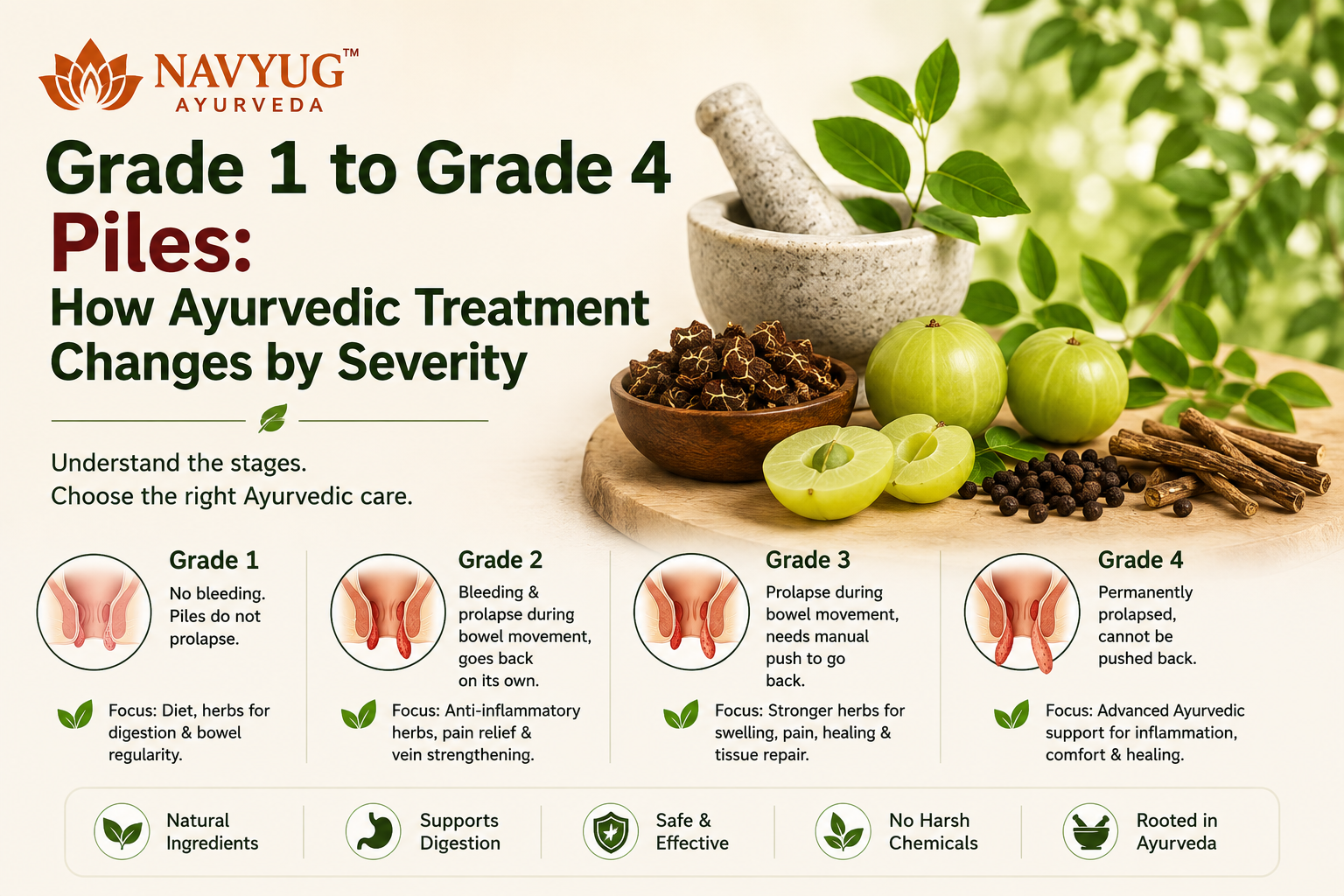
Piles are classified into four grades based on how much the pile mass prolapses — Grade 1 causes no visible prolapse, Grade 2 prolapses but retracts on its own, Grade 3 needs manual reduction, and Grade 4 is permanently prolapsed. Ayurvedic treatment shifts accordingly: Grade 1-2 responds well to diet, lifestyle, and herbal support, while Grade 3-4 typically needs Kshara Sutra therapy or surgical intervention alongside it.
I get asked “what grade am I?” constantly, and honestly, most people have never had a doctor actually explain the grading system to them — they just know it hurts and it’s not going away. So let’s actually walk through what each grade means and, more importantly, what changes in treatment as you move up the scale.
What Are the Grades of Piles, Exactly?
Piles classification is based on how much the internal hemorrhoid prolapses, or protrudes, out of the anus, using what’s clinically known as the Goligher grading system. This grading matters because it directly guides treatment choice, not just for describing severity.
Here’s the breakdown, using the standard clinical definitions:
Grade | What Happens | Visible/Felt Externally? |
Grade 1 | Small swelling inside the anal canal; may bleed | No |
Grade 2 | Prolapses during straining, returns on its own | Only during bowel movement |
Grade 3 | Prolapses, needs to be pushed back manually | Yes, until pushed back |
Grade 4 | Permanently prolapsed, cannot be pushed back | Yes, always |
What's the Difference Between Internal and External Piles Treatment?
Internal piles form above a boundary called the dentate line and are usually painless, while external piles form below it and tend to be genuinely painful since that area is far more sensitive to pain. This matters for treatment because internal piles are graded 1-4 based on prolapse, while external piles are managed more by symptom severity — pain, swelling, thrombosis — rather than a numbered grading scale.
Internal piles often go unnoticed until they bleed or prolapse, since the tissue above the dentate line isn’t pain-sensitive. External piles, by contrast, tend to announce themselves immediately through pain, itching, and visible swelling. Treatment for external piles leans more heavily on topical relief and anti-inflammatory support, while internal piles respond more to the grade-based approach below.
Herbs alone are usually enough for Grade 1–2 piles, but which formulation matters more as severity increases — our guide to the best ayurvedic medicine for piles breaks down what to use at each stage.
How Does Ayurvedic Treatment Change from Grade 1 to Grade 4?
Grade 1-2 piles are managed primarily through diet, lifestyle change, and herbal support, while Grade 3-4 usually needs a para-surgical procedure like Kshara Sutra alongside or instead of purely herbal treatment. This isn’t a strict cutoff — some Grade 2 cases benefit from Kshara paste application too — but it’s a reasonable general pattern for what to expect.
Grade 1-2: A high-fiber diet, adequate hydration, and Ayurvedic herbal formulations targeting digestion and bowel regularity are typically the first line of treatment. In Ayurveda, this stage is also understood through dosha imbalance — Vata aggravation tends to bring dry, hard stools and prolapse tendencies, while Pitta imbalance is more associated with bleeding and burning (a variety classically described as Raktarsha).
Grade 3: Herbal and dietary support still plays a role, but this is usually where Kshara — a herbal alkaline paste applied to the pile mass — comes into consideration. One clinical study evaluating 30 people with hemorrhoids found that topical Kshara paste applied for seven days resulted in measurable shrinkage of the pile mass, which is a genuinely useful data point if you’re wondering whether this para-surgical option actually does anything.
Grade 4: At this stage, Kshara Sutra therapy — a specially medicated thread tied at the base of the pile mass, working through gradual pressure necrosis — is the more definitive Ayurvedic option, sometimes alongside conventional surgical evaluation. Oral herbal formulations at this point are usually supportive, not primary.
I Have Grade 2 Piles — Will Ayurvedic Medicine Cure It Completely?
resolution through consistent Ayurvedic treatment for Piles consuming Best ayurvedic medicine for piles and lifestyle change. Since the pile mass still retracts on its own, it hasn’t yet reached the point of structural change that typically requires a procedure.
I’ve covered this in more depth in our complete guide on whether there’s a permanent cure for piles, but the short version for Grade 2 specifically: consistent fiber intake, adequate hydration, reduced straining, and a formulation supporting digestion and bowel regularity — like Bye Bye Piles Capsule, built around Nagarmotha, Triphala, Senna, and Nishoth — give you a genuinely reasonable shot at resolution, not just symptom management. It’s not guaranteed for every case, since individual healing varies, but it’s a realistic goal at this grade.
How Do I Know What Grade My Piles Are?
You generally can’t self-diagnose the exact grade reliably, since Grade 1 and early Grade 2 look and feel similar from the inside, and the distinction matters clinically. A doctor or Ayurvedic practitioner can determine this through a physical examination, sometimes with additional tests if needed.
That said, a rough self-check: if you’ve noticed a lump that comes out during a bowel movement but goes back in on its own, that’s a strong indicator of Grade 2. If you’re pushing it back in with a finger, that’s Grade 3. If it stays out permanently, that’s Grade 4, and it needs prompt medical attention rather than continued home management.
Step-by-Step: What to Do Based on Your Likely Grade
- No visible prolapse, occasional bleeding → Likely Grade 1. Start with diet, fiber, and hydration immediately.
- Prolapses during bowel movements, returns on its own → Likely Grade 2. Combine dietary change with a digestion-focused Ayurvedic formulation and give it 6-8 weeks.
- Prolapses and needs to be pushed back manually → Likely Grade 3. See a doctor or Ayurvedic practitioner to discuss Kshara or Kshara Sutra options alongside continued herbal support.
- Permanently prolapsed, doesn’t reduce → Likely Grade 4. This needs prompt professional evaluation — don’t rely on self-treatment at this stage.
- At any grade, persistent or heavy bleeding → See a doctor regardless of what grade you think you’re at, to rule out other causes first.
Frequently Asked Questions
What are the 4 grades of piles?
Grade 1 shows small internal swelling with no prolapse; Grade 2 prolapses during straining but retracts on its own; Grade 3 prolapses and needs manual reduction; Grade 4 is permanently prolapsed and cannot be pushed back. This grading, known as the Goligher system, directly guides which treatment approach is appropriate.
What is the treatment for Grade 2 piles?
Grade 2 piles typically respond well to a high-fiber diet, adequate hydration, and Ayurvedic herbal formulations that support digestion and bowel regularity. Many cases show significant improvement or resolution with 6-8 weeks of consistent treatment.
What's the difference between internal and external piles treatment?
Internal piles are graded 1-4 based on prolapse and are usually painless until they bleed or prolapse significantly, while external piles are typically painful from the start and managed more through topical relief and anti-inflammatory support. Treatment approach depends on which type you’re dealing with, not just severity.
Will Ayurvedic medicine cure my Grade 2 piles completely?
For many people, yes — Grade 2 is a stage where full resolution through consistent Ayurvedic treatment and lifestyle change is a realistic goal, since the tissue hasn’t reached the structural change seen in higher grades. It’s not guaranteed for every case, but it’s genuinely achievable for many.
How do I know what grade my piles are?
A rough guide: if a lump comes out during bowel movements and returns on its own, that suggests Grade 2; if you need to push it back manually, that’s Grade 3; if it stays out permanently, that’s Grade 4. A doctor or Ayurvedic practitioner can confirm the exact grade through examination.
Does Grade 4 piles always need surgery?
Grade 4 piles usually need more than oral herbal treatment alone, often involving Kshara Sutra therapy or surgical evaluation, since the tissue is permanently prolapsed at this stage. Prompt professional evaluation is important rather than continued self-management.

ABOUT THE AUTHOR
Dr. Iffat Rehman
B.Sc, BAMS (Bachelor of Ayurvedic Medicine & Surgery), Diploma in Dietetics & Nutrition (Ayurveda and Modern Nutrition)