


Blog
What Causes Piles, and How Does Ayurveda Treat Them?

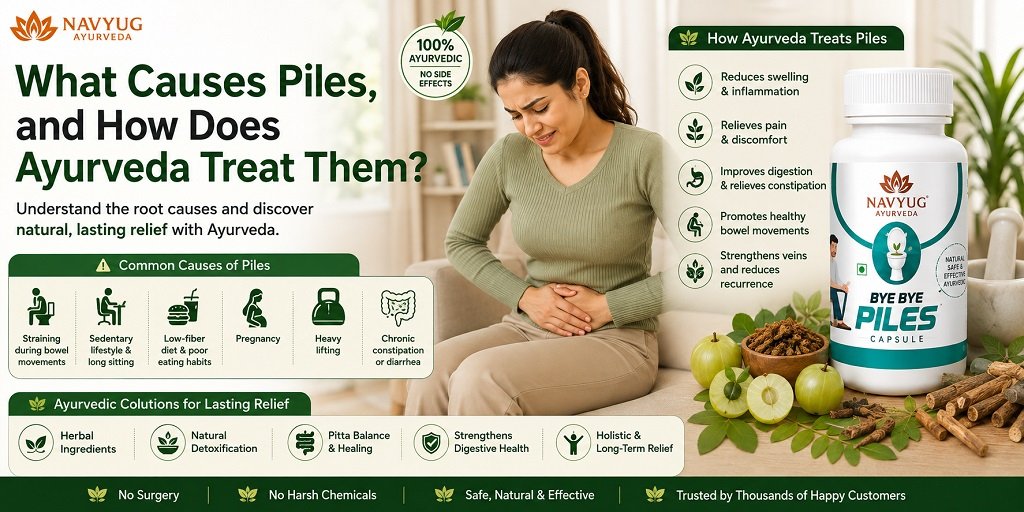
Piles (haemorrhoids) happen when the veins around your rectum or anus swell up, usually from straining, chronic constipation, or too much time spent sitting. Ayurveda calls this condition Arsha and traces it back to an imbalance in Vata and Pitta dosha the body’s energies governing movement and heat rather than treating it as a purely mechanical problem. Ayurvedic medicine for piles works by correcting that imbalance through herbs, diet, and targeted therapies, alongside procedures like Kshar Sutra for advanced cases.
Dr. Niveditha TS, BAMS, MBA (Hospital Management & Administration), RYT
What Exactly Are Piles, and What Does "Ayurvedic Medicine for Piles" Mean?
Piles are swollen blood vessels in your anal canal internal if they’re inside the rectum, external if they’ve formed under the skin around the anus. In modern medicine, they’re graded I to IV depending on how much they prolapse.
Ayurvedic medicine for piles isn’t one single formulation. It’s a treatment system herbal combinations like Kanchanar Guggulu and Triphala, dietary correction, and procedures such as Kshar Karma or Kshar Sutra, used together rather than any one pill doing the whole job. I tell my patients this upfront because a lot of the queries I get start with “which single medicine should I take,” and honestly, that’s not quite how this system is built to work.
What Causes Piles, According to Ayurveda? (The Dosha Connection)
Ayurveda attributes piles mainly to a Vata-Pitta imbalance, with Kapha playing a role in the swelling itself. Here’s how each dosha contributes:
Dosha | What it governs | How imbalance shows up in piles |
Vata | Movement, bowel function, elimination | Dryness and irregularity cause hard stools; straining injures the rectal veins |
Pitta | Digestion, metabolic heat | Excess heat shows up as burning, inflammation, and bleeding |
Kapha | Structure, lubrication | Contributes to the swelling and heaviness of the pile mass itself |
In classical texts like the Sushruta Samhita which actually has a whole section on anorectal disorders piles are described as arising when poor Agni (digestive fire) leads to Ama (undigested toxins) accumulating in the colon, which then aggravates Vata and Pitta together.
What I find interesting is how closely this maps onto what modern colorectal literature says, even though the language is completely different. Ayurveda and contemporary medicine both point to diet, lifestyle, bowel function, and mental state as major contributors to piles. Low-fibre, processed food and long sitting hours slow digestion in Ayurvedic terms (Mandagni) and cause straining in medical terms same mechanism, two vocabularies.
One thing worth naming honestly: everyone actually has haemorrhoidal tissue from birth it only becomes a problem once it swells and starts causing symptoms. So “having piles” isn’t really an abnormality showing up out of nowhere; it’s existing tissue getting aggravated, which fits the Ayurvedic idea of dosha imbalance disturbing something that was already functioning fine.
How Does Ayurveda Treat Piles?
Ayurvedic treatment for piles works on three fronts at once herbs, diet and lifestyle, and, where needed, procedures. It doesn’t rely on a single pill to “cure” the condition; the goal is symptom relief and dosha correction, with procedural intervention reserved for higher-grade piles.
- Herbal management. Kanchanar Guggulu is one of the most commonly used formulations it’s traditionally used to help reduce swelling and shrink pile mass. Triphala supports regular bowel movements without the harshness of a laxative, which matters because straining is exactly what aggravates piles in the first place. Nagkesar is often included where bleeding is a bigger concern than swelling. If you want the full rundown of individual formulations, dosing patterns, and how to pick between them, see our detailed guide to the best ayurvedic medicine for piles.
- Diet and Agni correction. Since poor digestion (Mandagni) is considered a root driver, dietary correction isn’t an afterthought it’s treated as part of the treatment itself. Fibre-rich foods, warm water, and avoiding excess spice, fried food, and red meat all come up repeatedly in classical guidance, mainly because they either aggravate Pitta (heat, bleeding) or dry out Vata (hard stools, straining).
- Procedures for advanced cases. For Grade III-IV piles, Ayurveda has its own procedural options Kshar Sutra (a medicated thread ligation technique) and Kshar Karma (application of an alkaline herbal paste). These aren’t home remedies; they’re done by a trained practitioner, and I’d be doing readers a disservice pretending herbs alone handle every stage.
How an Ayurvedic Piles Assessment Usually Goes
- Dosha and symptom evaluation pulse diagnosis (Nadi Pariksha) and history-taking to identify whether Vata, Pitta, or Kapha is dominant in your presentation.
- Grading the severity internal vs external, and how much prolapse or bleeding is involved, since this decides whether herbs alone are appropriate or a procedure is needed.
- Herbal and dietary protocol formulations chosen based on dominant dosha, not a one-size-fits-all combination.
- Lifestyle correction bowel habit timing, hydration, activity levels, since suppressing the urge to defecate is specifically called out in Ayurveda as a Vata aggravator.
- Review and escalation if needed if symptoms persist or worsen, referral for a procedural option rather than continuing herbs indefinitely.
In my own OPD experience, patients often come in expecting an instant fix and are surprised the first two weeks are mostly about fixing bowel habits and diet before the herbs even get a fair chance to work. That’s not a sales pitch it’s just how Agni correction actually plays out in practice, and it’s the part most generic blog posts skip over.
For readers who want the home-care side of this in more depth diet charts, sitz baths, what to avoid that’s covered separately in our piles diet and home remedies guide, so I won’t repeat all of it here.
Does Ayurveda Treat the Cause, or Just the Symptoms?
Both, depending on the stage. For Grade I-II piles, addressing Agni, dosha balance, and bowel habits genuinely targets root contributors not just masking discomfort. For Grade III-IV, or where there’s persistent bleeding, herbs mainly manage symptoms while a procedure addresses the structural issue. If you’re weighing Ayurvedic management against allopathic or surgical options, our comparison guide breaks down recovery time and suitability for each. Anyone with ongoing rectal bleeding should get it checked by a doctor regardless of which system they’re using, since bleeding can also flag conditions that need to be ruled out.
Frequently Asked Questions
How does Ayurveda treat piles?
Ayurveda treats piles by identifying which dosha is dominant, then combining herbs, diet, and lifestyle changes to correct that imbalance, with procedural options reserved for more advanced, prolapsed cases.
What is the connection between dosha imbalance and piles?
Vata imbalance causes dryness and straining, Pitta imbalance causes heat and bleeding, and Kapha imbalance contributes to swelling together, these are considered the root cause of Arsha (piles) in Ayurveda.
Can ayurvedic medicine cure piles permanently?
It can significantly reduce symptoms and shrink pile mass in early stages, but Grade III-IV or persistently bleeding piles usually still need a procedural intervention it isn’t a guaranteed permanent fix for every case.
Is ayurvedic treatment for piles safe?
Generally yes, when taken as directed and under guidance, but herbs can interact with existing medication or conditions, so it’s worth discussing with a practitioner rather than self-prescribing, especially during pregnancy.
How long does ayurvedic treatment take to show results in piles?
This varies by grade and dosha type mild, early-stage cases often see symptom relief within a few weeks of combined herbal and dietary correction, while advanced cases take longer and may still need a procedure. leo.

ABOUT THE AUTHOR
Dr. Iffat Rehman
B.Sc, BAMS (Bachelor of Ayurvedic Medicine & Surgery), Diploma in Dietetics & Nutrition (Ayurveda and Modern Nutrition)