


Blog
How Does Ayurveda Treat Obesity? Dosha, Agni and Ama Explained

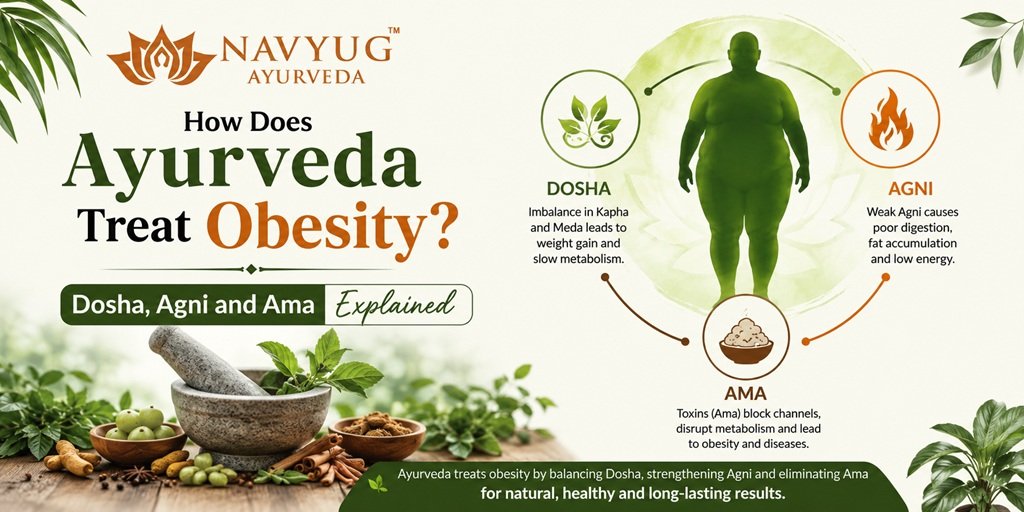
Ayurveda treats obesity, called Sthaulya or Medoroga, by correcting weak digestive fire (Agni), clearing accumulated toxins (Ama), and rebalancing Kapha dosha, the combination believed to cause excess fat tissue (Meda Dhatu) to build up faster than the body can use it. Treatment combines herbs, diet correction, and lifestyle change, with Panchakarma therapies used for more significant cases.
I want to walk through this properly, because most explanations either oversimplify it to “eat less Kapha food” or go so deep into Sanskrit terminology that it stops being useful. Let’s find the middle ground.
What Is Obesity Called in Ayurveda, and What Does That Actually Mean?
Ayurveda calls obesity Sthaulya, sometimes Medoroga, and classifies it among the Nindya Prakriti, a group of conditions the classical texts specifically flag as difficult to treat. That classification isn’t meant to discourage anyone, it’s an honest acknowledgment that obesity has always been recognized as a genuinely stubborn condition, not a simple one.
There’s a well known line from Ashtanga Hridaya, one of Ayurveda’s foundational texts: being lean is preferable to being obese. It’s blunt, but it reflects how seriously the condition was taken even centuries ago, this isn’t a modern reframing of an old idea.
What Causes Obesity, According to Ayurveda?
Obesity develops when Agni weakens, Kapha dosha becomes dominant, and Ama builds up as a result, disrupting how the body processes and distributes fat tissue (Meda Dhatu). Kapha governs structure and lubrication in the body, so when it’s out of balance, the tendency toward fat accumulation increases.
Here’s the part most explanations skip: Ayurveda describes nutrition moving through seven tissue stages in sequence, Rasa (plasma), Rakta (blood), Mamsa (muscle), Meda (fat), Asthi (bone), Majja (marrow), and Shukra (reproductive tissue), each stage nourishing the next. In Sthaulya, this process stalls specifically at the Meda stage. Fat tissue keeps accumulating while the deeper tissues, bone and marrow particularly, don’t get properly nourished.
That’s a genuinely useful way to understand why someone can be overweight and still show signs of poor nourishment elsewhere, low energy, brittle nails, weak bones, at the same time. The fat tissue is overfed while the tissues beyond it are underfed, which is a different picture than “excess calories,” even though both frameworks are describing related territory.
How Does Ayurveda Actually Treat Obesity?
Ayurvedic treatment for obesity works across three lines, correcting the cause, herbal support, and Panchakarma detoxification where needed, rather than relying on any single intervention alone.
Approach | What It Targets | Example |
Nidana Parivarjana | Identifying and removing the actual cause, whether diet, inactivity, or daytime sleeping | Correcting a Kapha aggravating routine before anything else |
Aahara and Vihara | Diet and lifestyle correction | A Kapha pacifying diet, regular activity, avoiding daytime sleep |
Aushadha | Herbal formulations | Guggul and Triphala for fat metabolism and digestion |
Shodhana (Panchakarma) | Deeper detoxification for more significant cases | Virechana or Udvartana under supervision |
Removing the cause comes first in classical texts, before medicine even enters the picture, which is worth sitting with. A herbal formulation working against an unchanged Kapha aggravating routine, heavy food, inactivity, daytime sleep, will always be fighting an uphill battle.
What Ayurvedic Treatment Is Suitable for an Overweight Person, Specifically?
It depends on how significant the imbalance actually is, not everyone needs the same intensity of intervention. Mild Kapha imbalance with early weight gain typically responds well to diet correction and herbal support alone. More established obesity, particularly where digestion is significantly compromised, tends to need Panchakarma therapies alongside the herbal and dietary pieces, done under proper supervision rather than attempted independently.
This is also where modern classification is genuinely useful alongside the Ayurvedic framework, BMI-based obesity classes give a concrete starting point for how aggressive a treatment plan needs to be, even though Ayurveda itself doesn’t use BMI as its primary lens.
Does Ayurveda Treat the Cause, or Just the Symptoms?
For most cases, genuinely the cause, since correcting Agni and Kapha imbalance addresses the actual mechanism, not just the visible weight. This is a real point of difference from some conventional approaches. Appetite suppressants and lipase inhibitors, common pharmaceutical options, work by blocking symptoms of the problem, hunger, fat absimilation, rather than correcting the underlying metabolic dysfunction, and they carry their own documented side effects as a result.
That’s not a criticism of modern medicine broadly, both systems have their place, but it does explain why an Ayurvedic approach tends to take longer to show results: it’s working on the mechanism, not suppressing the symptom.
Frequently Asked Questions
How does Ayurveda treat obesity?
Ayurveda treats obesity, called Sthaulya or Medoroga, by correcting weak Agni (digestive fire), clearing Ama (toxin buildup), and rebalancing Kapha dosha through herbs, diet, lifestyle change, and Panchakarma therapies where needed. Removing the underlying cause is considered the first step, before medicine.
What is the Ayurvedic solution for obesity?
There’s no single solution, it’s a combination of Nidana Parivarjana (removing the cause), Aahara and Vihara (diet and lifestyle correction), herbal formulations like Guggul and Triphala, and Panchakarma detoxification for more significant cases. The specific combination depends on how established the imbalance is.
What Ayurvedic treatment is suitable for an overweight person?
Mild cases typically respond to diet correction and herbal support alone, while more established obesity, especially with compromised digestion, tends to need Panchakarma therapies under supervision. The right starting point depends on the severity of the imbalance, not a one-size approach.
What is Sthaulya in Ayurveda?
Sthaulya, also called Medoroga, is the Ayurvedic term for obesity, understood as excessive accumulation of Meda Dhatu (fat tissue) caused by weakened Agni and Kapha dosha imbalance. It’s classified among the Nindya Prakriti, conditions classical texts specifically describe as difficult to treat.
Is Ayurvedic treatment for obesity as fast as modern weight loss medication?
No, and it isn’t designed to be. Ayurvedic treatment corrects the underlying digestive and metabolic mechanism rather than suppressing appetite or blocking fat absorption, which is why it typically takes weeks rather than days to show visible change.
Can Ayurveda treat obesity without Panchakarma?
Yes, for mild to moderate cases, herbal formulations combined with diet and lifestyle correction are often sufficient. Panchakarma becomes more relevant when digestion is significantly compromised or progress has stalled despite consistent effort.
Where to Go From Here
Understanding the mechanism is the first step, applying it is the harder part. If you’re looking for the herbal side of this treatment specifically, our full guide to ayurvedic medicine for weight loss breaks down formulations and evidence in depth. If abdominal fat is your main concern rather than overall weight, our belly fat guide covers that mechanism specifically, including why spot reduction isn’t realistic even within this framework.

One thought on “How Does Ayurveda Treat Obesity? Dosha, Agni and Ama Explained”